
Accueil

Filtrer

Infrastructure aid and resource trade: the crossroads of strategy and sustainable development

Date : Jeudi | 2026-11-05 à 12h30
Lieu : Salle des thèses

Lien TEAMS : Cliquez ici pour rejoindre le séminaire du LÉO

Thais Nunez-Rocha (Université d'Orléans)

We investigate whether rich countries use development aid to secure access to natural resources. Our model shows that even an altruistic donor may allocate more infrastructure aid to recipients from whom it receives more resource exports. Using CRS project-level data over 2006-2021, with a 2001-2011 robustness sample, we estimate a fixed-effects ladder of increasing stringency. Resource trade is positively associated with the number of infrastructure projects: a one-unit increase in the resource-trade term is associated with an 8 to 14 percent increase in the expected number of projects across specifications. This association is statistically significant under donor-recipient pair clustering but not under two-way clustering by donor and recipient, nor under a wild cluster bootstrap over donors. A positive value effect appears only in our most demanding, fully saturated specification and is only marginally significant under the bootstrap. No single resource category robustly drives the result, road is the only transport mode with a significant effect, and, in the fully saturated specification, greater oil tanker fleet capacity is linked to a smaller aggregate effect. We interpret our findings as a systematic but fragile allocation pattern, not a causal effect.

Epidemic Risk and the Breakdown of Analyst Information Channels:Evidence from China’s Zero-COVID Policy

Date : Mardi | 2026-11-10 à 12h
Lieu : Salle des thèses

Lien TEAMS : Cliquez ici pour rejoindre le séminaire du LÉO

Sandy Suardi  (University of Wollongong)

This paper examines how regional epidemic risk during China’s COVID-19 Zero-COVID
period affected financial analysts’ earnings forecast accuracy and related behaviors. Using
analyst- and firm-level forecasts for A-share-listed firms from 2020–2021, we show that higher
local epidemic risk significantly reduces forecast accuracy at both annual and quarterly
horizons. Two mechanisms drive this decline. First, strict lockdowns and travel restrictions
impede analysts’ ability to conduct on-site due diligence, with the adverse effects more
pronounced for distant and out-of-province analysts. Second, heightened uncertainty and
operational disruptions amplify information asymmetry, especially for non-SOEs, small firms,
firms with greater earnings management, and firms audited by non-Big 4 auditors. Epidemic
risk also reshapes analyst practices: it reduces coverage, increases forecast dispersion, raises
the likelihood of forecast revisions, and encourages team collaboration as analysts attempt to
mitigate informational frictions. Overall, the findings provide large-scale evidence that
epidemic-induced disruptions fundamentally weakened analysts’ information sets and
forecasting precision. The results highlight the vulnerability of capital-market information
production to external shocks and underscore the importance of robust information channels
when face-to-face information gathering becomes constrained.

Climatic litigations and GHG emissions

Date : Jeudi | 2026-10-15 à 12h30
Lieu : Salle des thèses

Lien TEAMS : Cliquez ici pour rejoindre le séminaire du LÉO

Inmaculada Martínez-Zarzoso (Université de Jaume I)

This paper provides the first empirical evaluation of the impact of climate litigation on greenhouse gas emissions. Using a stochastic version of the Impact, Population, Affluence and Technology framework and a sample of developed and developing countries over the period 1996–2023, we employ panel-data methods with instrumental variables and a staggered DID approach to address endogeneity. Results show that following a decided litigation, emissions decrease by around 1.8% according to the more conservative estimates. This effect is most pronounced in high-income countries. Our findings suggest that the judiciary acts as a critical enforcement mechanism, bridging the gap between legislative intent and climate action.

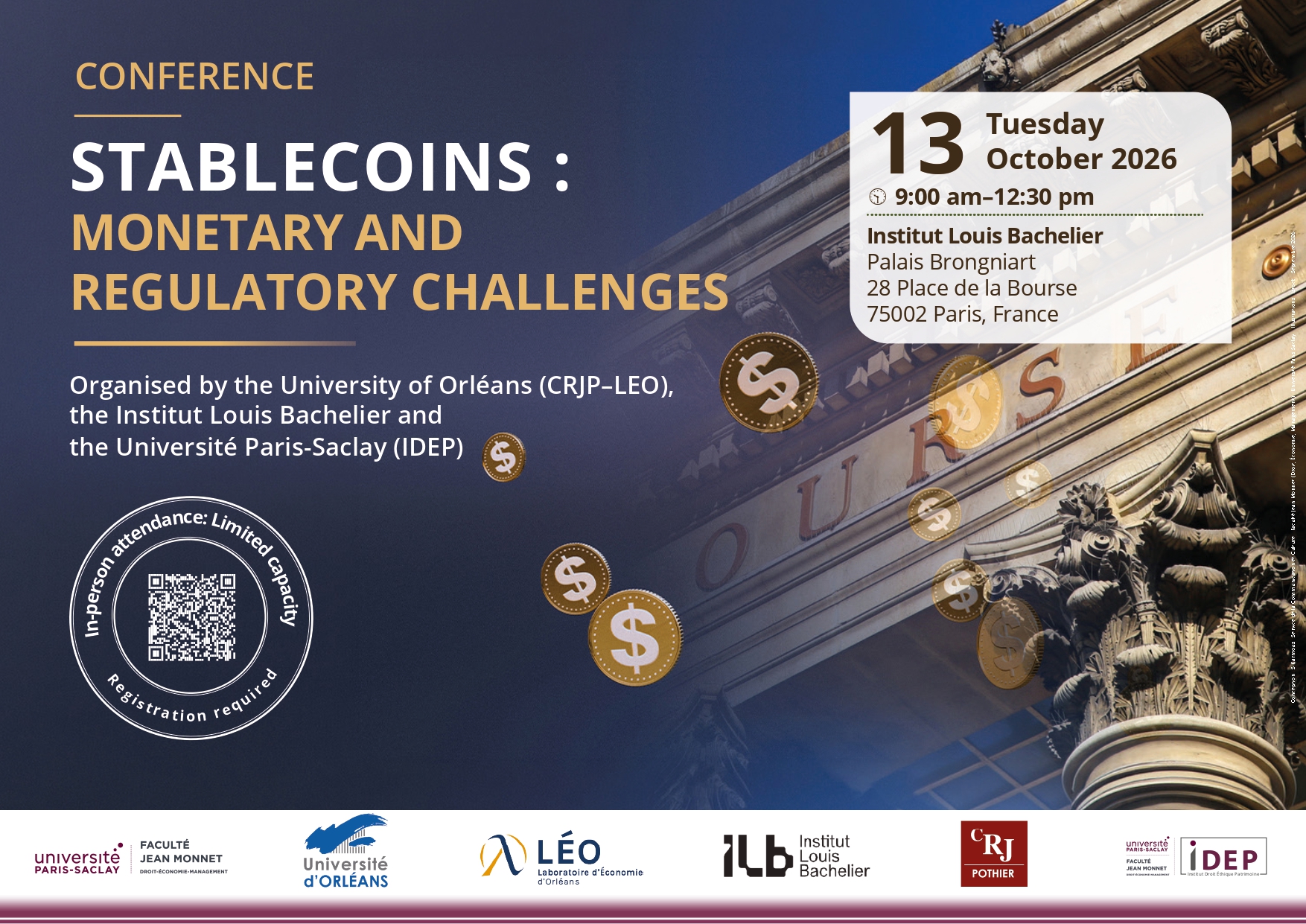
Stablecoins : Monetary and Regulatory Challenges

Date : Mardi 13 octobre 2026 à 09h00
Lieu : Paris (Institut Louis Bachelier - Palais Brongniart)

Organisateur(s) : Université d'Orléans - Institut Louis Bachelier - Université Paris-Saclay

Les stablecoins jouent un rôle de plus en plus important sur les marchés des actifs numériques, ce qui soulève d’importantes questions monétaires et réglementaires. Cette conférence rassemble des économistes, des universitaires et des experts juridiques afin de discuter de l’évolution du paysage des stablecoins à la lumière de la révision en cours par la Commission européenne du règlement sur les marchés des crypto-actifs (MiCA) et des récentes évolutions réglementaires dans d’autres grandes juridictions.

Programme_STABLECOINS MONETARY AND REGULATORY CHALLENGES_13oct2026_page-0001

IA générative et recherche en économie: choc d’offre et rupture

Date : Jeudi | 2026-10-08 à 12h30
Lieu : Salle des thèses

Lien TEAMS : Cliquez ici pour rejoindre le séminaire du LÉO

Christophe Hurlin (Université d'Orléans / LEO)

Ce séminaire propose d’examiner la manière dont l’IA générative transforme les pratiques de recherche en économie, de la rédaction et la programmation à la revue de littérature et à l’évaluation des travaux. Il discutera à la fois des gains de productivité permis par ces outils et des questions qu’ils soulèvent en matière de qualité scientifique, de peer review et d’évaluation de la recherche.

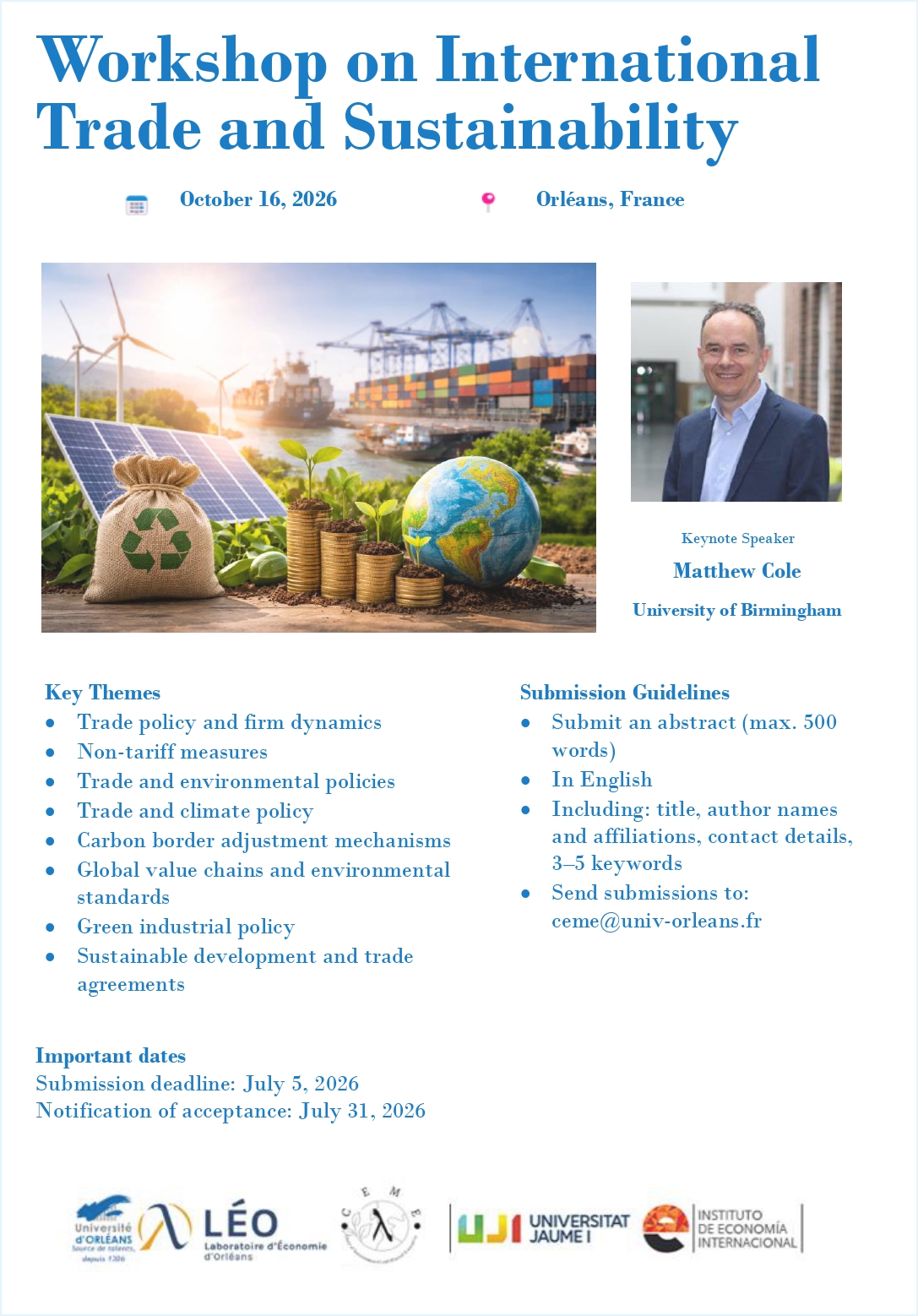
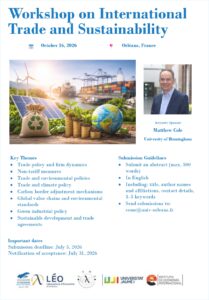
WITS 2026

Date : Vendredi 16 octobre 2026 à 09h00
Lieu : Salle B.103 - UFR DEM'O

Organisateur(s) : Chair of Environmental and Mineral Economics - LÉO

Organisé par la Chaire d’Économie Environnementale et Minière et l’Institute for International Economics, ce workshop réunira des chercheurs travaillant sur les interactions entre commerce international et enjeux de soutenabilité. L’objectif de cette première édition est de favoriser les échanges scientifiques et le dialogue interdisciplinaire autour des grands défis économiques et environnementaux auxquels sont confrontées les économies contemporaines.

Les différentes sessions de la journée aborderont plusieurs thématiques au cœur des débats actuels :

  • Énergie, environnement et accords commerciaux;
  • Déforestation et empreinte écologique;
  • Chaînes de valeur mondiales et environnement.
Flyer 2026_page-0001

Conférence Annuelle « Les ECOPOL »

Date : Vendredi 25 septembre 2029 à 09h00
Lieu : MAME – Cité de la Création et de l’Innovation, Tours

Organisateur(s) : LÉO

Dans un contexte marqué par la multiplication des crises géopolitiques, la montée des tensions commerciales internationales, les recompositions régionales et la course aux ressources stratégiques, les ÉCOPOL#2026 proposent un regard croisé sur les transformations économiques et politiques actuellement à l'œuvre.

Ouverte tant au monde académique qu'aux acteurs économiques, institutionnels et au grand public, cette manifestation s'impose désormais comme un rendez-vous incontournable de réflexion sur les défis mondiaux contemporains.

Affiches ecopol 2026_page-0001

15th FAERE Thematic Workshop

Date : Jeudi 05 & Vendredi 6 juin 2026
Lieu : Hôtel Dupanloup - Salle de Lecture

Organisateur(s) : LÉO - Université d'Orléans

L’objectif est de réunir des chercheurs travaillant sur l’intégration des enjeux environnementaux dans les analyses macroéconomiques : climat, biodiversité, pollution, politiques publiques, finance verte, commerce international, etc.

Intervenants principaux

Site officiel

JTFAERE 2026

Call for paper - 15th FAERE Thematic Workshop_page-0001